MOLECULAR  BIOLOGY  OF  HUMAN  PAPILLOMAVIRUSES                                  


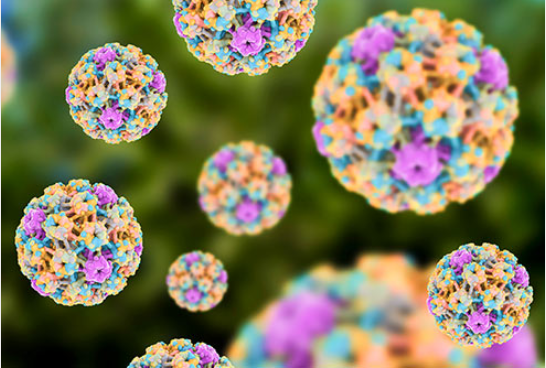
1.    Human papillomaviruses (HPVs) are a family of small DNA viruses consisting of over 150 related genetic types, of which more than 85 are fully sequenced.  The genome is encapsidated in an icosahedral protein coat, and there is no membrane envelope.  The HPVs are rather closely related through phylogenetic and biological properties to the animal papillomaviruses, which are host-specific to other vertebrates including amphibians, reptiles, birds and a variety of land and sea mammals.  HPVs do not infect any other species, nor do any of the animal papillomaviruses infect humans.


2.    The HPVs target either cutaneous or mucosal epithelium, each type at a preferred body site, and cause warts.  Plantar, common and flat warts of the cutaneous, external epithelia are usually associated with HPV genotypes 1, 2, 3 or 4.  HPV -5, -8 and related types cause the rare skin disease epidermodysplasia  verruciformis, from which 40% of the patients progress to cancer.  HPV types 6 and 11 cause benign ano-genital condylomas, upper aerodigestive tract papillomas (most notably laryngeal papillomas), and conjunctival and ear canal papillomas.  Infections with HPV-16 and HPV-18 and numerous related genotypes often occur in or near the squamo-columnar junctions of the cervix, penis, anus, or aerodigestive tracts.  These lesions can progress from benign condylomata to dysplasias and occasionally to carcinomas.  New papillomavirus-associated cancers arise in about 600,000 patients in the world each year.  When caught early in the disease process, they can be treated surgically.  There are but few effective antiviral drugs, and prophylactic and therapeutic vaccines are only in the initial stages of development and testing.


3.    The viral genome consists of a circular double-stranded DNA approximately 7,900 base pairs long (range 7400-8200).  Most viral genotypes have a very similar genetic, transcriptional and functional  organization consisting of a transcription and replication control region, an early (E) region encoding proteins for replication, regulation and modification of the host cytoplasm and nucleus, and a late (L) region encoding capsid proteins.


4.    The upstream regulatory region (URR), also known as the long control region (LCR), contains the origin of DNA replication, one or two promoters, transcriptional enhancer and repressor protein binding sites, and the late RNA poly-adenylation site.  It is subject to very complex interactions with both viral and host regulatory proteins.


5.    All genes are transcribed from the same DNA strand.  There are several promoters active at different stages of infection, and separate early and late polyadenylation sites are used.  Transcripts are processed using a large number of alternative splice donor and acceptor site combinations, allowing them to encode sets of related proteins that share some common sequences and perform related functions.


6.    The viral DNA persists as nuclear, extra-chromosomal plasmids at moderate copy numbers (eg. 20 episomes per cell) in the cycling basal and parabasal keratinocytes.  Infections generally remain subclinical.  Productive infections that can culminate in the release of progeny virions require terminal differentiation of stratified epithelium to enable the activation of differentiation-dependent viral promoters.   Reactivation of a latent infection leads to a programmed sequence of high level expression of the viral genes, vegetative DNA replication and virion morphogenesis in the superficial strata of the epithelium.


7.    The E1 and E2 genes, at least, are expressed in basal and parabasal cells. Families of alternative E1 and E2 proteins serve as regulatory factors that either repress or activate transcription.  They also comprise the viral replication origin-binding proteins that recruit the host replication proteins to the origin.  The host heat shock proteins hsp70 and hsp40 facilitate the assembly of the pre-replication complex, particularly the formation of a di-hexamers of E1 joined by hsp40 into two rings around the DNA. These  E1:hsp40 complexes remain associated with the replication elongation complex as an ATP-dependent DNA helicase, and E1 protein is the only enzyme encoded by the papillomaviruses.  Host DNA polymerase   is recruited by E1, and the single-stranded DNA binding protein RPA by E2 protein.  E1, E2, pol   subunits p180 and p70, and other proteins in the preinitiation complex are phosphorylated by cyclin E/cdk2 complexes to trigger the elongation phase of replication, thus providing the biochemical link to cell cycle control.  


The E5 trans-membrane protein is found in the plasma membrane as well as in the Golgi and endoplasmic reticulum membranes.  It modulates EGF receptor activity and other protein trafficking.  The E4 protein directly or indirectly interacts with cytokeratin filaments (for unknown reasons).


E6 and E7 genes are normally expressed in the differentiated spinous strata of the epithelium.  E7 protein is essential to establish cellular conditions under which the viral DNA can replicate in the non-cycling, differentiated keratinocytes of squamous epithelia, through the following mechanism:  The host retinoblastoma susceptibility (tumor suppressor) protein is a cell cycle regulatory protein which recruits cellular histone deacetylase to particular promoters controlled by the E2F:DP family of transcription factors.  Promoters associated with pRB -  E2F:DP complexes are thereby repressed due to chromatin condensation.  The papillomaviral E7 protein dissociates pRB from E2F, leading to the local decondensation of the chromatin and induction of a large suite of host genes needed for deoxyribonucleotide synthesis and DNA replication.  E7 also interacts with pRB-related proteins including p107 and p130.  Moreover, it activates an additional pathway for induction of proliferating cell nuclear antigen (PCNA), the processivity factor for host DNA polymerase- .  The cells move into S phase, and both cellular and viral DNA replicate.  However, such reactivated, differentiated cells do not generally progress to mitosis.


E6 protein binds to and inhibits the host cell p53 tumor suppressor protein.  Among other consequences, this delays both programmed and defensive apoptosis of the keratinocytes, most likely to allow more time for viral reproduction.   E7-mediated progression of the differentiated cells into S phase also triggers the translation of pre-existing host mRNA encoding the p21cip1 inhibitor of cyclin-dependent kinases and of PCNA.  p21cip1 binds to the cyclin D/cdk2 and cyclinE/cdk4  complexes, and the cell cycle transition from G1 phase into S phase is blocked.   p21cip1 also can bind to PCNA, and those DNA replication forks already engaged in synthesis are blocked from further elongation.  However, such unscheduled DNA replication is successfully inhibited some but not all of the infected cells.  Thus some cells accumulate inhibitory amounts of inactive p21cip1 / cyclin E / PCNA complexes, while others fail to accumulate p21cip1, and the active PCNA is able to support de novo synthesis of viral and host DNA.  Apparently the timing of cyclin E induction and p21cip1 induction relative to the availability of other host replication factors helps determine the fate of individual, infected cells.  As a consequence, natural and experimental papillomas are a mosaic of productive and inhibited cells.


L1 is the major capsid protein and L2 is the minor capsid protein.  E2 protein most likely participates in selecting viral DNA for packaging into progeny virions by associating with the E2 binding motifs in the replication origin and also complexing with the L2 protein..


8.    Wound healing of HPV-infected epithelium can result in temporary up-regulation of the E6-E7 genes in basal-like cells.  In addition, mutations of the host cell or virus that result in over-expression of the viral E6 and E7 genes in basal and parabasal stem/reserve cells may trigger excessive cell cycling.  Thus, if the viral DNA integrates into a host cell chromosome with local insertional damage, with the deletion of the viral E2 regulatory gene, and/or with up-regulatory effects of the flanking host sequences on the E6-E7 promoter, the infected cells may become able to proliferate and accumulate secondary mutations that eventually can lead to carcinomas.  In overview, the different patterns of regulation of E6 and E7 expression are very complex and can account for apparently contradictory observations in natural and experimental settings.


9.         A healthy cell-mediated immune system down-modulates HPV activity by mechanisms not yet known, while transient or long-term immunosuppression can lead to reactivation of latent infections, onset of epithelial hyperproliferation and pathologic changes, and virus reproduction.