HUMAN PAPILLOMAVIRUSES AND ASSOCIATED DISEASES
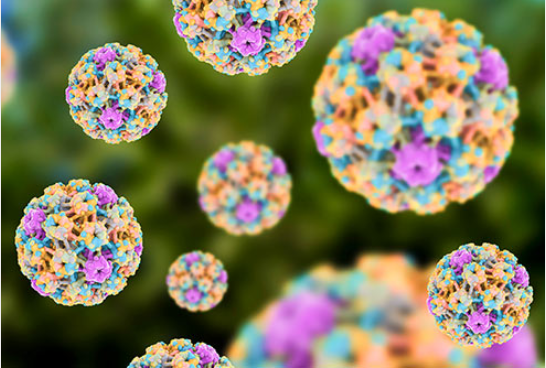
Human papillomaviruses are characterized by their non-enveloped icosahedral capsid containing a circular double-stranded DNA genome, which is about 7900 base pairs long. Viral infections target both cutaneous and mucosal surface epithelia. During normal infections, the successive stages of viral gene expression and DNA replication are dependent upon the complete program of squamous differentiation. A dozen or more viral proteins are encoded by complex families of alternatively spliced messenger RNAs derived from a single transcribed viral DNA strand.
Over 85 distinct but related genotypes have been molecularly cloned and sequenced , and at least 65 additional types have been provisionally identified by PCR amplification in a conserved region of a capsid gene. Viral types are now defined as having less than 90% identity in DNA sequence with any other prototype, and most HPV types are from 55% to 85% identical. Portions of certain viral genes such as L1 and E1 are more highly conserved, and this sequence similarity makes it possible to determine whether clinical specimens harbor HPV. Tissue samples can be subjected to single set or nested polymerase chain reaction amplification with cross-hybridizing primers, followed by analysis with both generic and type-specific probes to determine which, if any, HPV types are associated with the lesion. Some clinical specimens yield multiple HPV types.
Different HPV types are trophic for the various kinds of cutaneous or mucosal epithelium, and they have different pathogenic effects. All papillomaviruses necessarily establish benign infections in order to persist in the epithelium and to reproduce. Only certain types additionally have an oncogenic potential and, at low frequency, they can induce dysplasias that might over time progress to high grade neoplasias and eventually to carcinomas. Over three dozen different HPV types are, as a group, trophic for the ano-genital mucosa and cause what are the predominant venereal diseases of viral etiology. Papillomaviruses can also be transmitted to the genital or laryngeal mucosa of babies during natural delivery. HPV types -6 and -11 produce benign exophytic genital warts (condyloma acuminata) and laryngeal papillomatosis. Cervical and penile dysplasias are generally associated with HPV-16, -31,-33, -35, -52 and -58 or with HPV-18, -39, -45 and -70 and related types; they have a small potential to develop into squamous-, adeno- and small cell carcinomas and to metastasize. Tumor progression is often associated with viral DNA integration, loss of viral repressor genes, mutation of several host genes and accumulation of chromosomal abnormalities. The cytological changes associated with HPV infection form the basis of Papanicolaou (Pap) smear screening. The overall incidence of genital tract infection is estimated to involve 60% to 75% of the world's sexually active population. Worldwide, about 600,000 new cases of cervical and penile cancer arise each year. Many of these individuals will suffer significant morbidity or die because early detection and appropriate medical treatment are not possible or available.
Nonetheless, most papillomaviral infections are sub-clinical and persistent. Papillomaviruses typically emerge from latency during healing of wounds of infected epithelium or following transient or permanent immunodeficiency or suppression associated with sunburn, pregnancy, physical and emotional stress, aging, cancer and cancer chemotherapy, organ and bone marrow transplantation, or HIV infection /AIDS. Some people seem to have inborn genetic disorders of immunological function that cause them to be susceptible to particular HPV genotypes. There is currently no effective strategy for prophylactic vaccination, although clinical trials of potential vaccines are now underway. There are no pharmacological means to cure established HPV infections, but many lesions can be managed to some degree with surgery, cytotoxic agents, or modulators of skin proliferation or differentiation.
The staggering economic impact and the profound negative consequences for individuals, families and society as a whole cannot be over-emphasized. Women in the United States, for example, spend over two billion dollars each year on Pap smear cytology during routine preventive screening. Those having active HPV infections require three billion dollars cost in additional care in the form of colposcopic examination, biopsy, localized surgery or hysterectomy. Despite this intensive medical effort, about 4,500 American women die of cervical cancer each year, at a personal and social cost that is immeasurable. In that the family of genital HPV diseases appears to be sexually transmitted, men too harbor and express HPV in the form of penile and perianal warts and urethal papillomas. A subset of these lesions will also progress to cancers.
Perhaps the most tragic and challenging manifestation of HPV infection is laryngeal papillomatosis, which occurs in a small portion of the children born to women with genital warts, perhaps 500-2000 per year in the U.S. About 3000-4000 children and an equal number of adults remain under regular surgical care at any time, and a estimated total of 13,000 Americans have laryngeal and other airway infections. The juvenile-onset disease typically manifests itself between the ages of one and five, when the children develop a hoarse cry, then sudden and acute respiratory distress. Many afflicted children (perhaps 25,000 per year in the world) die of asphyxiation before emergency care can be provided. Many of the survivors generally then require laser surgery under full anesthesia every two to three months for a decade or more, hence the name recurrent respiratory papillomatosis. A substantial number of the patients undergo 50-600 laser operations over the course of the disease. The cost to keep affected children alive can run to $100,000 or more per year. No family can afford this, and these children as well as several thousand adult and adult-onset patients are treated under compassionate care provided by physicians, hospitals and public funds, subsuming in the U.S. more than one hundred million dollars annually.
Papillomaviruses cause other types of lesions of the head and neck region, including the oral/pharyngeal cavity (gingiva, tongue, soft and hard palette and, especially, tonsils), the nasal mucosa, the conjuctiva of the eyes, and the ear canal. Some of these infections, especially in the nasal passages, can progress to invasive and fatal cancers. Under no circumstances should they be treated with irradiation. In cutaneous skin, virtually every human has had common warts on the hand and face, plantar warts on the feet, or flat warts on the arms, back and chest. These too can be cosmetically disfiguring, very uncomfortable or downright painful. Such infections are the clinical domain of dermatologists, podiatrists and pediatric infectious disease specialists. Again, billions of dollars are spent annually on professional and over-the-counter medical care. What is not fully appreciated by most people is that these lesions may go into remission after an active period of months or years, but they usually are not fully eliminated. Upon immunosuppression, the skin warts can reappear. Cutaneous warts and genital condylomata have become major complications of solid organ transplantation (now numbering 20,000 new transplants per year in the U.S., with the likelihood of HPV disease increasing over time for many patients), and bone marrow transplantation (25,000 recipients annually in the U.S., with the papilloma problem subsiding over the course of a year or so as immunosuppressive therapy is diminished). Other temporary medical situations such as cancer chemotherapy can result in reactivation of latent infections. Significant reactivation of pre-existing infections even becomes a concern during pregnancy as a woman's immunological status adjusts to carrying a fetus. Although the precise nature of immune surveillance of HPV infections is not known, it is likely that many of the active cases of various kinds of warts actually result from an inborn (genetic) inability to recognize critical epitopes of specific virus types. Thus, individuals who clinically express certain HPV types do not seem to be unusually susceptible to active disease by any other but the most closely related types.
A great deal of new biomedical research is needed to understand the molecular, cellular and immunological basis for HPV infection, to work toward safe and effective vaccines, and to develop experimental systems for antiviral drug discovery and testing. The time has never been more necessary and more appropriate for this international research effort. Based on the very rapid progress over the past 25 years, the investment in time and financial resources will be returned to society many-fold. Indeed, the current commercial-based research has grown directly out of the efforts of scientists, physicians and epidemiologists at universities and public institutions and now involves many of the major pharmaceutical firms and dozens of smaller biotechnology companies devoted to HPV-associated diseases. Together, the annual US research investment on HPV-associated diseases can be estimated at $50,000,000 - $100,000,000. This is clearly a significant commitment of resources and people, but one that still is quite small considering the annual cost to society of this family of dreadful diseases.
It is toward the purposes of basic scientific and clinical research, communication and collaboration, professional and public education and patient advocacy that the international papillomavirus research community has met since 1975, and annually since 1982. This dedicated group of research investigators, clinical care givers, and public health workers representing over 40 countries is now formally incorporated as the International Papillomavirus Society.